
At LATTIMEX we look for ideas where others don't. This time the question was unexpected: can a circuit from an insect's brain help load a truck?
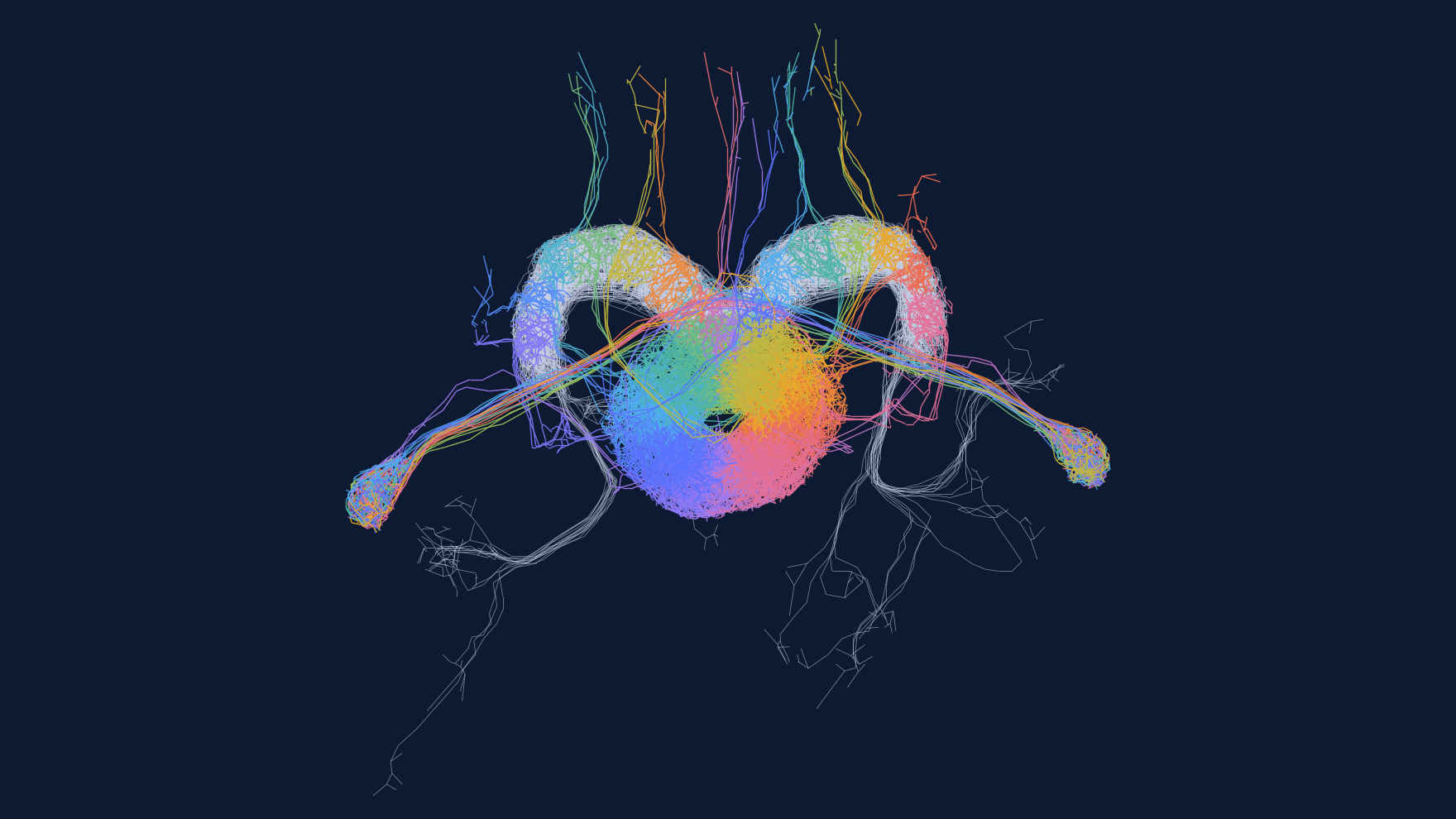
The fruit fly finds its way with a kind of internal compass. A ring of neurons in the center of its brain keeps track of which way it is facing. Thanks to the MaleCNS connectome, the complete map of the connections in a fly's brain, we can read that circuit neuron by neuron and synapse by synapse.
What we did was take that circuit, understand what computation it performs and turn it into a rule a computer can execute in microseconds. We call this process distillation of natural algorithms.
A compass of 88 neurons
The starting point is the Male CNS connectome, published by the FlyEM team at Janelia Research Campus together with the Cambridge Connectomics Group and Google Research. Using electron microscopy, it reconstructs the entire central nervous system of a male fly: the brain, the optic lobes and the ventral nerve cord. Version 1.0 came out in June 2026, and the data are open under the CC BY 4.0 license, which allows reuse and transformation with attribution.
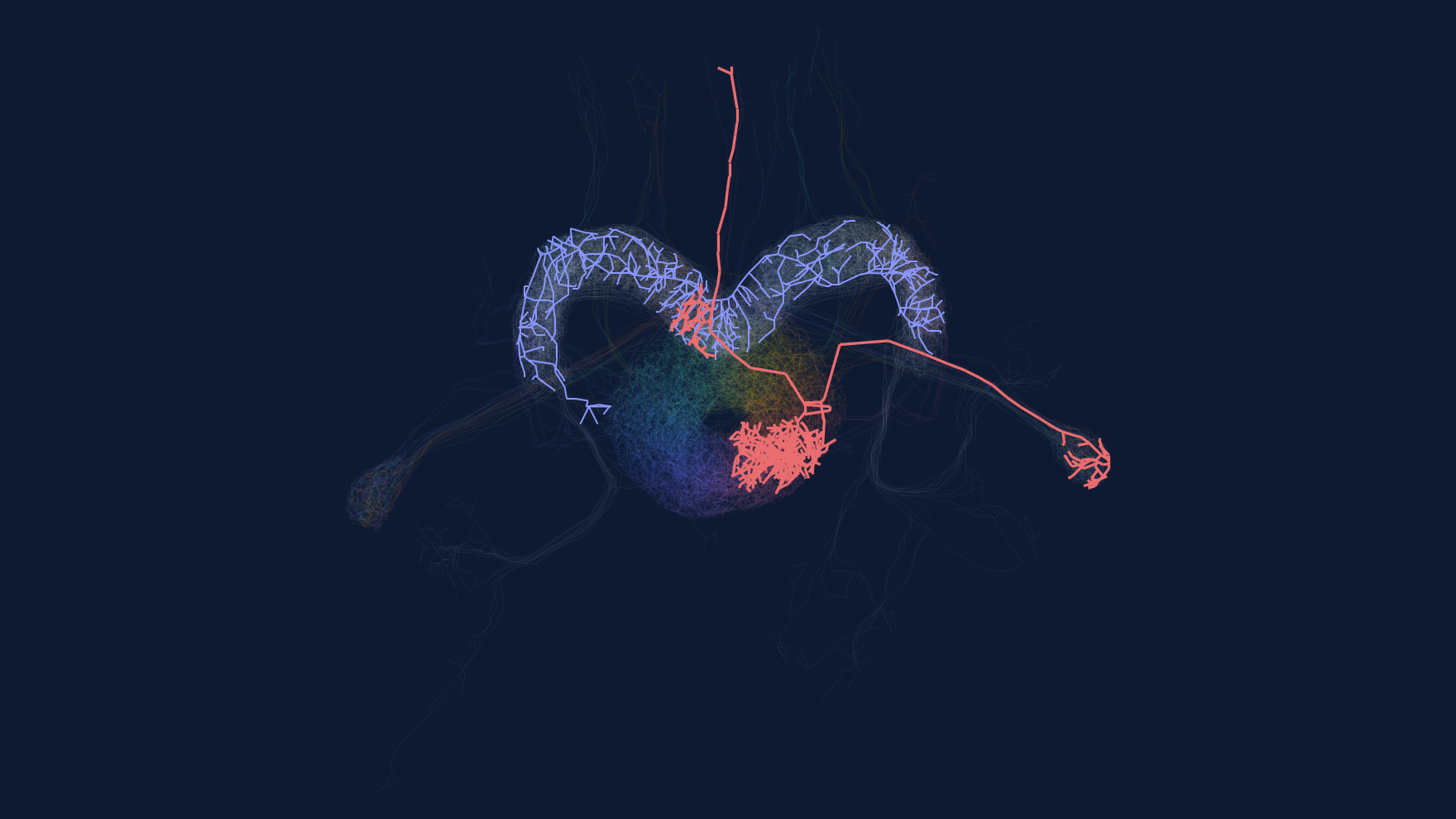
The circuit we chose links two populations of the central complex: 46 EPG neurons and 42 Delta7 neurons, joined by 2,149 connections. When one sector of the ring becomes active, Delta7 projects that activity to the opposite side. It is a natural counterweight mechanism.
That whole transformation fits exactly into a 16 × 16 matrix: 256 numbers, with no approximation error. Each number keeps the imprint of the fly's real wiring.
From the connectome to the truck
- Brain map. We started from Janelia's MaleCNS connectome, reconstructed with electron microscopy and published as open data.
- Isolate the circuit. We extracted the EPG → Delta7 → EPG compass and verified its anatomy connection by connection.
- Distill it. We condensed its complete function into the 16 × 16 rule and checked that no neuron is redundant.
- Put it to work. We divided the truck floor into the same 16 sectors as the ring. The circuit reads how much weight is in each one and decides which wall the next box leans against.
- Test it against everything. We measured it on new loads against our baseline method, a classic counterweight and 64 fly brains with scrambled wiring.
The safety rules are not decided by the fly: the engine guarantees them for every box. Rotation only about the vertical axis, at least 75% of the base supported, nothing heavy on fragile items, the vehicle's maximum weight and a loading order that lets each stop unload without moving the boxes for the following stops.
What we measured
Fly-guided loading took practically the same volume as our baseline method. What changed was the distribution: the weight ended up better balanced between the left and right sides of the truck.
How the fly decides
You can try the circuit right here. Each column of the matrix is a stimulated sector; the ring shows where it responds. The strongest response appears on the opposite side: that is the counterweight signal we use in the truck.
Each number in the matrix summarizes real synapses. A single EPG connects one sector of the compass to the protocerebral bridge, and a single Delta7 spreads its signal along the whole arc. That's how the circuit carries information from one side of the ring to the opposite one.
Frontier, with method
A striking idea is not enough. That's why we work the same way as in any other LATTIMEX research line:
- Design on some data, measure on other data.
- Rivals included. We compared against a hand-written classic counterweight, the simplified mathematical version of the circuit and 64 fly brains with scrambled wiring. The real wiring achieved the best balance.
- Every box, audited. A program independent of the one that does the loading checks collisions, support, fragility, weight and unloading order in every load.
From a fly's brain to your operation
To use this circuit we had to understand it at an unusual level of detail. We reviewed 88 neurons one by one, counted their 2,149 connections and checked every synapse against the official source. We confirmed that the distilled rule reproduces the circuit without error. Then we audited every box in every load: where it rests, what it carries on top and in what order it comes out.
That same care is what we put into each customer's operation. A delivery plan fails in the details nobody wrote down: the box that can't be turned because it doesn't fit sideways, the pallet that can't go on top of fragile goods, the stop that ends up blocked at the back, the truck that had capacity on paper but not at the dock. That's why, before optimizing, we decode how your operation works:
- Your cargo, as it is. Dimensions, weights, allowed orientations and fragility of each type of parcel.
- Your real fleet. Interior dimensions, payload and how goods are loaded and unloaded on each vehicle.
- Your delivery sequence. Which stop comes first, what must stay within reach and what can't move along the way.
- Your unwritten rules. What your team does from experience and a system must respect.
With that information, every plan LATTIMEX proposes can be executed exactly as designed, and every improvement is measured against your current way of working, with your own data.
Frontier research makes sense when it ends in a better operation. This is one of the many ideas we explore so that every LATTIMEX plan is more efficient, safer and easier to execute.
From research to your operation
See how your own cargo would be loaded.
We can start with a sample of your orders and vehicles to visualize the 3D loading, validate the constraints and measure the result on a real case.